D.R. Thorn

"Some stories don't end. They just stop being told."

Also from the city

All books

Murray

A police profiler is hired to catch a serial killer stalking the predators the system set free — and every page of the profile he writes points back at himself. Dexter meets Mindhunter, with the net closing in real time.

Eleven men have vanished from western Massachusetts. No bodies. No witnesses. No suspects. Dr. Murray Kemp is the forensic psychologist helping police profile the killer. He's also the killer.

See the book: Murray

Something Remembers Case No. 1

The Understory

Nine workplace accidents in four months. One worker who walked into the fog and never came back. And an insurance claim that reads like someone hired a lawyer to write a ghost story.

See the book: The Understory

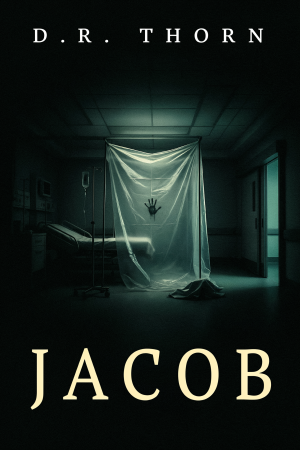
Jacob

For four years, the only way Nurse Emily Green has touched the boy in Room 12 is through rubber gloves sealed into a vinyl wall.

See the book: Jacob

Night log

  • 2026-07-27

    What Dialogue Doesn't Say

    The worst line of dialogue I have ever cut answered the question it was asked.I do not remember the scene anymore, but I remember the line, because I remember the relief of deleting it. A character asked another character what was wrong. The second character said what was wrong. Two lines of dialogue, doing exactly…

  • 2026-07-14

    The Rule Nobody Sees: How to Make the Supernatural Fair

    The worst thing a horror novel can do is let the monster do whatever the scene requires.You have read this book. The haunting is patient for six chapters and then suddenly omniscient in chapter seven, because chapter seven needs a jump scare. The curse is selective. It kills the strangers and spares the family, until…

  • 2026-07-06

    Why I Write Horror Cold

    There are two ways to write horror, and most readers can identify which one they prefer within ten pages.The first way is warm. The prose has texture. The atmosphere is dense. The autumn light is amber, the wind moves through the trees with intention, the old house has a pulse. The narrator is generous with…

  • 2026-07-06

    Why Your Hometown Is a Horror Novel

    Somewhere in your town there's a meeting happening right now. Seven people sitting around a folding table in a room that smells like industrial carpet and old coffee. They're talking about a culvert. Or a setback variance. Or the renewal of a conditional-use permit for a property on the edge of the commercial district.Nobody's watching…

  • 2026-07-01

    What I Owe the Reader, and What I Don't

    A novel is a contract.The reader opens the book and agrees to a set of terms they cannot fully see. The writer wrote the book under a set of terms they may not have fully articulated. The two sets overlap, but they are not identical. Most of what goes wrong between a horror novel and…

  • 2026-05-13

    On Discovery Writing: What I Learned Drafting Without an Outline

    I do not outline my novels.I have a story bible. I have a sense of who the people are and where they live and what kind of trouble is going to find them. I have, usually, an opening image and a closing one. The place the book starts and the place the book ends, with…

  • 2026-04-23

    The Summative Declaration: How Good Prose Goes Bad in the Last Sentence

    There is a specific way that good writing turns into telling, and it almost always happens in the final sentence of a scene.The writer has done the work. The scene is built out of concrete details. The character has moved through the space. The objects on the table have weight. The dialogue has been clipped…

  • 2026-04-06

    Institutions Are Scarier Than Monsters

    A monster can be killed. A bureaucracy cannot.This is the unfair advantage of institutional horror, and it is the reason I keep coming back to it. The monster in the woods is a problem with a solution. You find the right weapon, you learn the right rule, you survive until dawn. The institution is a…